
AI learns permission,
and the world learns coexistence.
CoReset is the rights and
settlement infrastructure for the AI era.
Enabling lawful data use for AI,
protecting creators' rights,
and supporting fair value sharing for all.
Converted from KRW at a fixed rate of 1 USD = 1,300 KRW
"Consumers create the value of digital data,
but the profit always goes to the platforms."
PROBLEM 01
AI Industry's Greatest Barrier
Is Not Technology or Infrastructure.
It Is Permission From Data Producers.
DATA PRODUCER IN ACTION
ANY JOINT OWNER
CAN STOP AI LEARNING
AND THE PROVISION OF AI SERVICES,
EVEN IF JUST ONE PERSON OPPOSES.
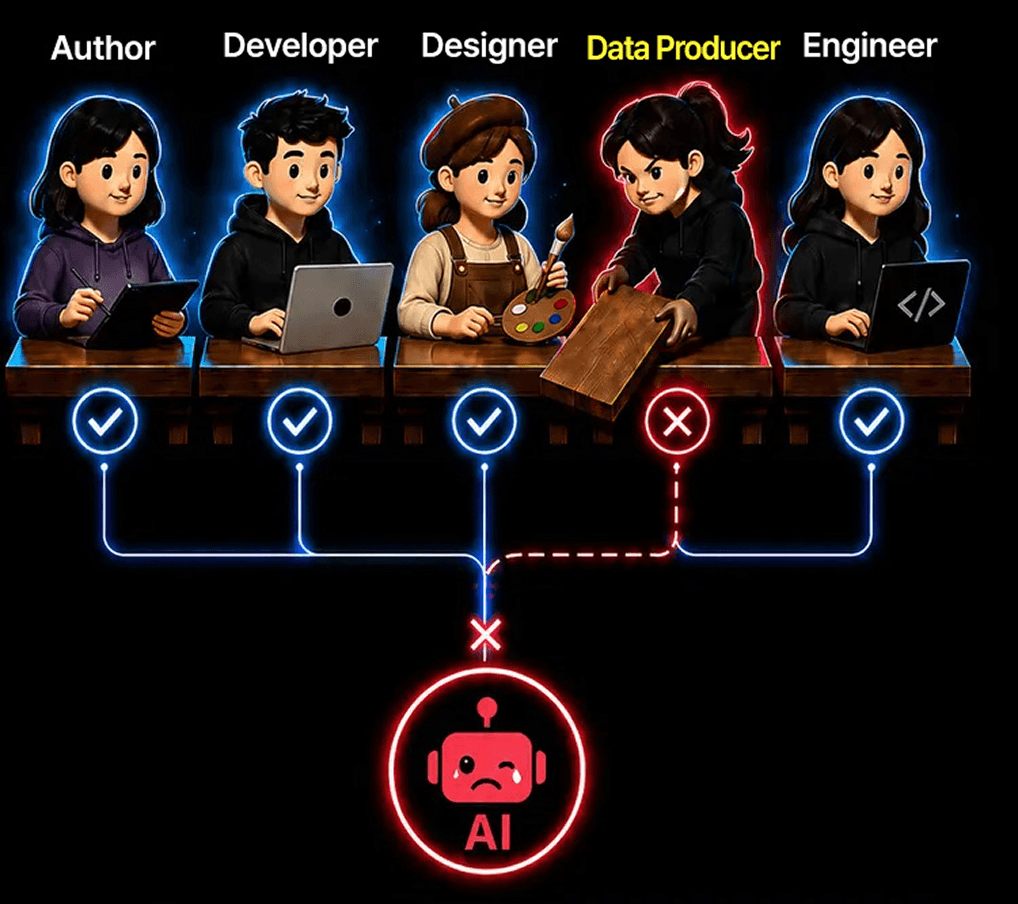
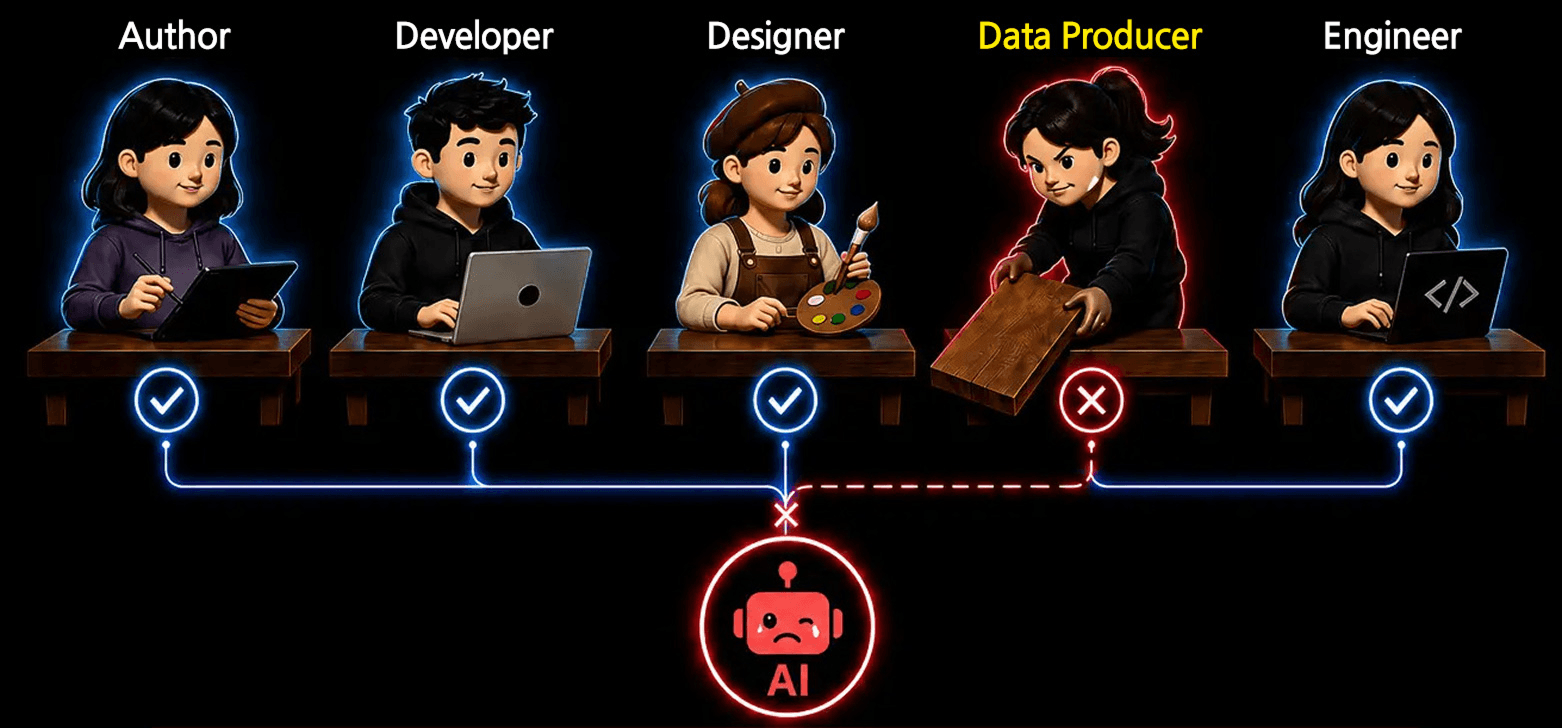
AI can learn from billions of documents, images, videos, and datasets.
Today, the AI industry is focused on securing GPUs, semiconductors, and data centers.
However, the greatest bottleneck in the AI era is not GPUs. It is rights holders.
In structures involving multiple rights holders—such as co-owned copyrights, co-owned patents, shared databases, and jointly owned intellectual property—
even a single rights holder's objection may limit AI training permissions, licensing agreements, and the utilization of intellectual property.
Current copyright and IPR systems provide mechanisms for registering and protecting rights.
However, they face significant challenges in efficiently managing and proving:
- Who the actual rights holders are
- Who has granted permission for use
- Who has objected to such use
- The scope of authorized use
- How these facts can be demonstrated and enforced against third parties
For AI companies, there is an issue even more important than acquiring data itself.
They must determine from whom authorization should be obtained for the use of specific data and content, and whether such authorization has been lawfully granted by the legitimate rights holders.
AI is already ready to learn. GPUs are ready. Data centers are ready.
However, unless a clear framework exists for obtaining permissions from intellectual property rights holders and compensating them appropriately, the scope of AI utilization will inevitably remain limited.
Ultimately, the greatest challenge facing the AI industry is not technology, but the authorization and compensation of rights holders.
CoReset is a Real Web3.0 Intellectual Property Economy System for the AI era
that connects rights holders, verifies usage permissions,
and ensures that fair compensation flows to data producers and creators.
PROBLEM 02
Why Can't AI Fairly Compensate
Data Producers?
Why can't data creators get
fair compensation from AI?Why can't data creators get fair compensation from AI?
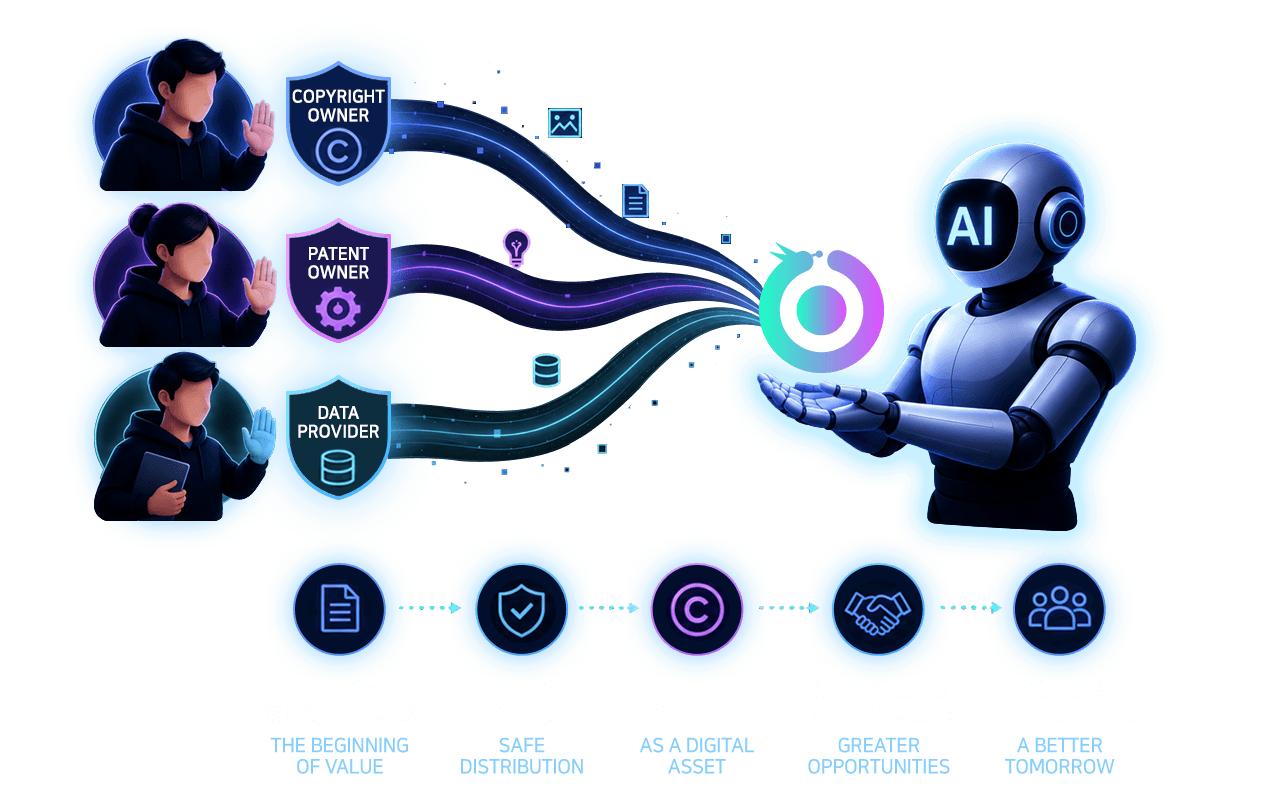
Today, AI learns from data, content, and behavioral records created by people.
Yet it operates without proper compensation.Today, AI learns from data, content, and behavioral records created by people.
Yet it operates without proper compensation.
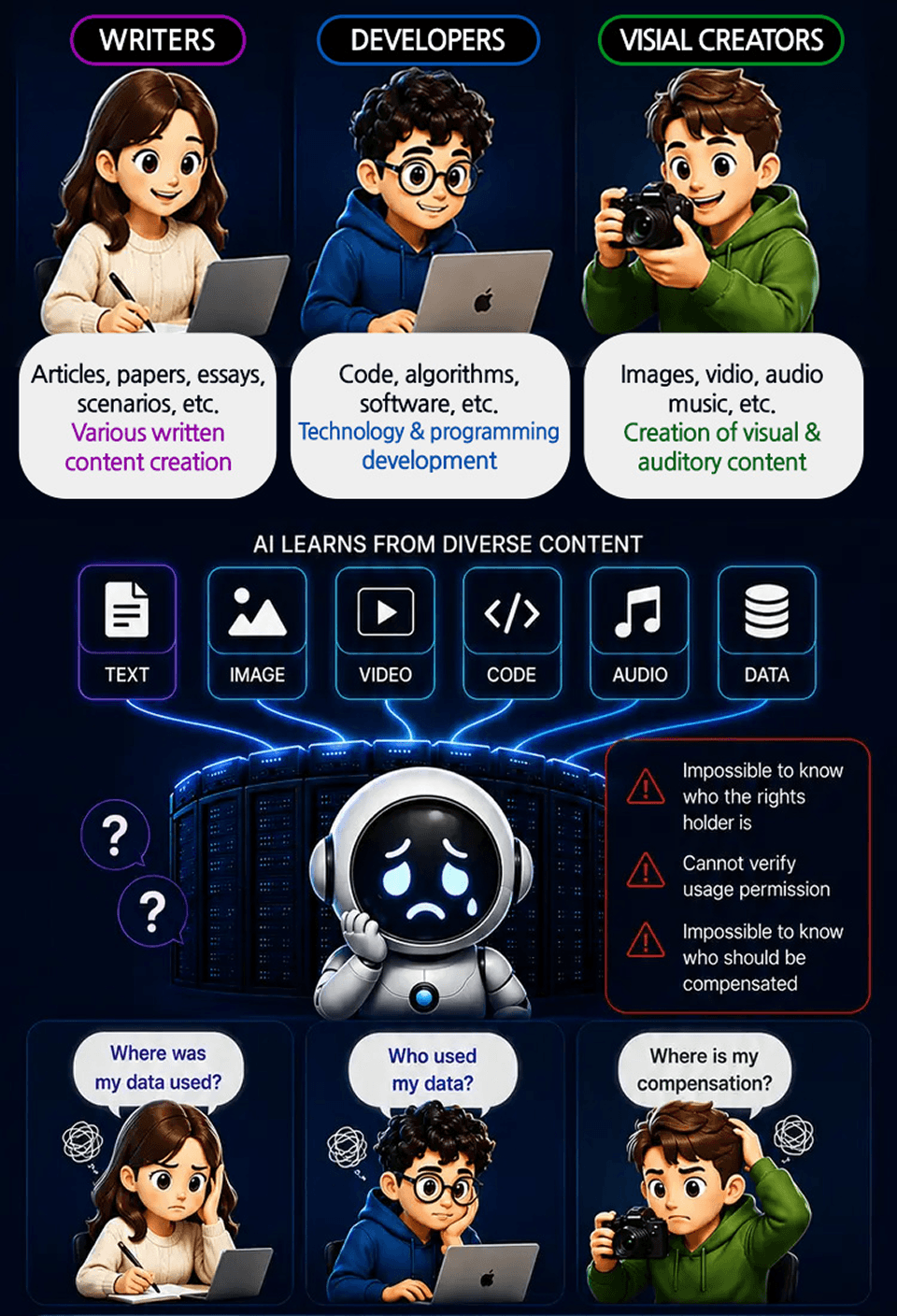
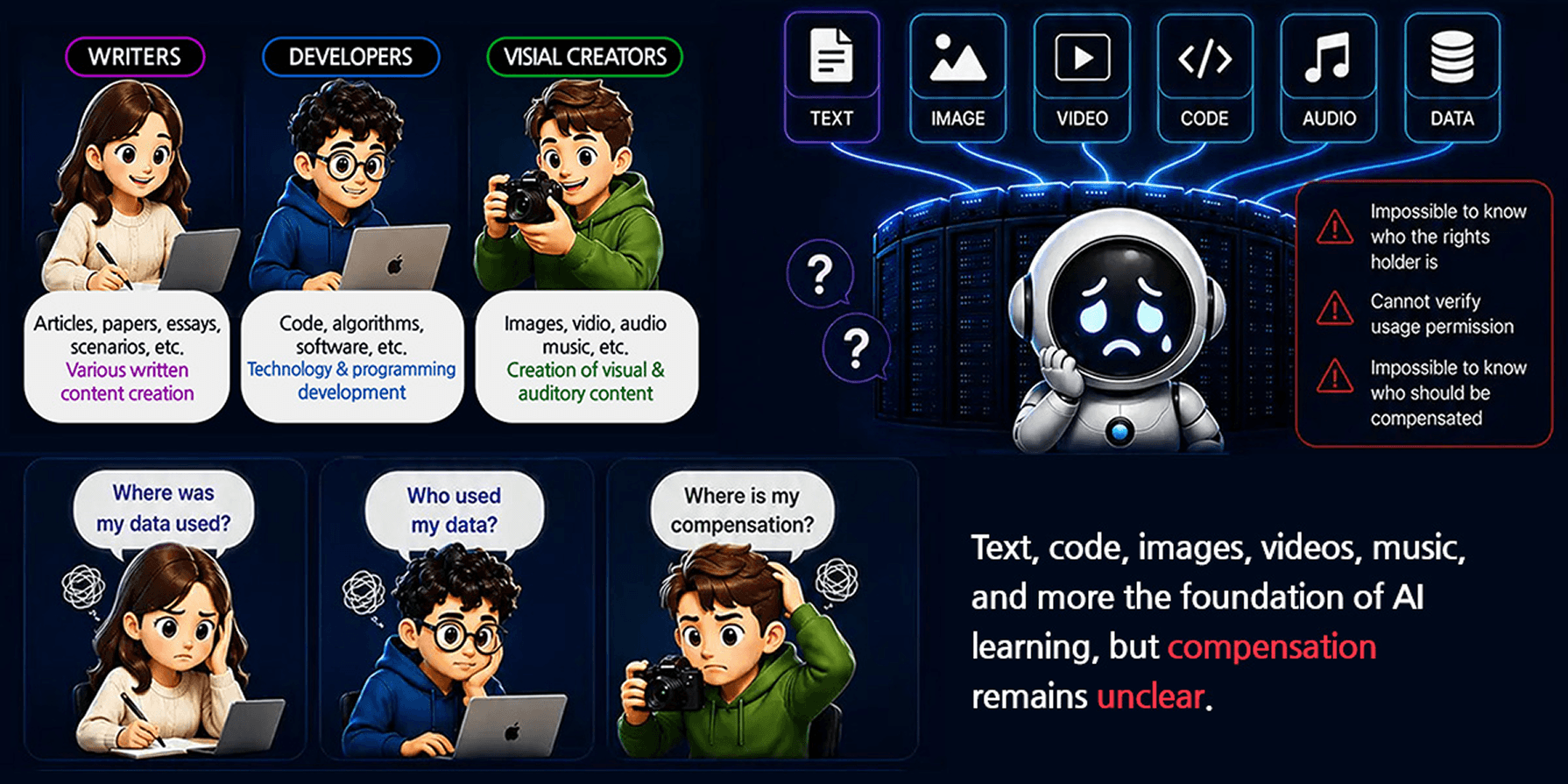
Text, code, images, videos, music, and more,
the foundation of AI learning,
but compensation remains unclear.Text, code, images, videos, music, and more, the foundation of AI learning,
but compensation remains unclear.
CoReset is the solution.CoReset is the solution.
- Verify rights, permissions,
and usage transparentlyVerify rights, permissions, and usage transparently - Record whose data was used and howRecord whose data was used and how
- Ensure fair compensation
for all contributorsEnsure fair compensation for all contributors
A fair compensation system for the AI era,
CoReset makes it happen.
A fair compensation system for the AI era,
CoReset makes it happen.
Today, most AI systems are trained on data, content, and behavioral records created by humanity.
However,
in a system where identifying rights holders and obtaining usage permissions remains difficult
- Data producers often receive no compensation.
- Creators struggle to verify whether and how their works have been used.
- Platforms continue to utilize and monetize data.
- The contributions and rights of contributors are often neither recorded nor recognized.
As a result, while the AI industry continues to grow,
the contributions of data producers and creators are not being fairly recorded, compensated, or settled.
APPROACH
CoReset Solution
Compensation Flows
When Permissions Are Verified and Recorded.
METHOD 1
Rights Sharing System
Ownership Remains the Same, Only Rights are Shared
Ownership remains unchanged,
while the rights to generate royalties
from any future resale are shared.
METHOD 1
Rights Sharing System
Ownership Remains the Same, Only Rights are Shared
Ownership remains unchanged,
while the rights to generate royalties
from any future resale are shared.
- 01
Retain IP Ownership
Ownership remains exactly the same.
- 02
Separate Rights to Royalties
(Only separate the rights to future royalties)
- 03
Issue Digital Rights Certificate
(Limited issuance)
- 04
Allocate Shares
(Divide into 100% shares)
- 05
Trade & Transfer
(Private sale · Auction · Secondary market)
- 06
Automated Royalty Distribution
(Settled automatically by share ratio)
- No IP ownership transfer
- No joint registration needed
- Only royalty rights separated
- Digital certificate issuance
- Rights can be traded
- Royalties auto-distributed
METHOD 2
Exclusive Usage Rights +
IP Share System
METHOD 2
Exclusive Usage Rights +
IP Share System
- 01
Maintain IP Ownership
The ownership of the IP remains unchanged.
- 02
Grant Exclusive Usage Rights to the 3rd Party
Grant exclusive usage rights to the 3rd party (companies, platforms, operators, etc.)
- 03
Set IP Share Ratio
Define the IP share linked to the exclusive usage rights revenue.
- 04
Issue Electronic Certificates
Issue electronic certificates based on the exclusive usage rights and IP share.
(Issued as IP share certificate) - 05
Distribute IP Shares
Distribute IP shares to joint administrators. (100% divided into shares)
- 06
Enable Trading and Transfer
IP shares can be traded and transferred. (General trading, auction, secondary market)
- 07
Automated Royalty Settlement
Royalties are automatically settled and distributed according to the share amount.
- IP shares are held jointly
- No need for joint ownership
- Trading of IP shares is possible
- Electronic certificates can be issued
- Only receiving rights can be separated
- Automatic royalty distribution is possible
Rights Verification
Verify who the rights holders are
and who has granted consent.
Rights Verification
Verify who the rights holders are
and who has granted consent.
Joint Rights Holder
Registration
Register all joint rights holders.
- Rights Holder Information
- Ownership Share Allocation
- Rights Relationship Mapping
DAO Verification
Verify rights
through a transparent governance process.
- Consent
- History
- Contribution Records
- Verification
Rights are transparently verified and
trust is established.
Rights Utilization & Revenue Generation
Rights are used, and value is generated.
Registered and verified rights are used across AI and various services to generate continuous revenue.
Rights Utilization & Revenue Generation
Rights are used, and value is generated.
Registered and verified rights are used across AI and various services to generate continuous revenue.
- 01
AI Data Training Utilization
Use registered rights data
for AI training.- Data Collection
- AI Model Training
- Performance Improvement
- 02
AI Copyright Utilization
Apply original rights transparently
to AI-generated outputs.- Copyright Protection
- Copyright Display
- Source Attribution
- 03
AI Data Rewards
Compensate rights holders fairly
whenever their data is utilized.- Usage Tracking
- Reward Calculation
- Automatic Payout
- 04
Revenue Distribution
Distribute generated revenue transparently
to rights holders.- Revenue Aggregation
- Distribution Ratio Application
- Payout to Rights Holders
- Enable AI & service utilization
- Accurate data rewards
- Copyright protection & source transparency
- Sustainable revenue generation
- Synergistic ecosystem between rights & AI
- Fair compensation for rights holders
- Transparent settlement system
- Maximize the value of rights
Rights Settlement & Distribution
Contributions are recorded,
rewards are settled.
Registered and verified rights are settled fairly
to data producers, creators, and co-rights holders based on pre-defined rules.
Rights Settlement & Distribution
Contributions are recorded,
rewards are settled.
Registered and verified rights are settled fairly
to data producers, creators, and co-rights holders based on pre-defined rules.
- 01
Royalty Calculation
Calculate contribution
and settlement ratios
based on usage data.- Usage Aggregation
- Contribution Analysis
- Settlement Ratio Calculation
- 02
Settlement Execution
Settle AI data rewards
and royalties automatically.- AI Data Rewards
- AI Royalties
- Automatic Settlement
- 03
Rights Holder Distribution
Distribute settled revenue transparently
to rights holders.- Data Producers
- Co-rights Holders
- Revenue Distribution
Transparent distribution builds trust
and drives sustainable value.
- Reward Data Producers
- AI Data Rewards
- AI Royalty Settlement
- Co-rights Holder Distribution
- Transparent Settlement History
- Automatic Payouts
CoReset Rights & Settlement ArchitectureCoReset Rights & Settlement Architecture
- 01
Input Layer
- Documents
- Images
- Datasets
- 02
Rights Classification
- Copyright
- Patent
- Data Rights
- 03
License & Consent
- AI Training
- Commercial Use
- Royalty Terms
- 04
Verification Layer
- Content ID
- Usage Log
- ZKP Verification
- 05
Event Ledger
- Permission Record
- Usage Record
- Audit Trail
- 06
Settlement Layer
- Royalty
- Distribution
- Settlement
- 07
Governance Layer
- Voting
- Policy
- Governance
CoReset Permission ProtocolCoReset Permission Protocol
- 01
Register
Rights owner registers content, data,
or IP information in the CoReset system. - 02
Classify
The system automatically analyzes
and classifies the rights and usage conditions. - 03
Consent
Users request permission for specific purposes (e.g., AI training), and the rights owner grants consent.
- 04
Verify
The system verifies whether the usage complies with the granted permission.
- 05
Settle
Royalties are automatically calculated based on usage verification and executed accordingly.
- 06
Govern
DAOs manage policies, resolve disputes,
and continuously improve the protocol.
Supported RightsSupported Rights
Copyright
The exclusive right to reproduce, distribute, and control original works.
Joint Copyright
The right shared by two or more creators
in a collaborative work.Patent Rights
The exclusive right to prevent others
from making, using, or selling an invention.Trademark Rights
The exclusive right to use symbols, names,
or logos that distinguish goods or services.Datasets
Collection of data organized for storage, management, and analysis.
Software
The programs, code,
and related documentation protected by law.Digital Assets
Digital items or media that exist
and are owned on the blockchain.AI Data
Data used to train, validate,
and improve artificial intelligence models.
Applicable IndustriesApplicable Industries
Artificial Intelligence
AI technology development
and integrated solutionsData Centers
Data storage, management, operation
and infrastructureGovernment &
Public SectorPublic service improvement
and smart administration solutionsMedia
Digital content production
and media platform developmentManufacturing
Smart manufacturing innovation
and automation solutionsHealthcare
Medical technology innovation
and healthcare management solutionsDistribution
Distribution innovation
and supply chain management solutionsGaming
Game development
and entertainment solutions
Use CasesUse Cases
AI Companies
Permission and licensing infrastructure
for developing and operating AI models
and services- AI Model Training
- AI Service Operations
- Data License Management
Data Centers
Infrastructure for verifying permissions
and rights, and supporting settlement
in large-scale AI environments- Permission Verification
- AI Training Rights Verification
- Royalty Settlement Infrastructure
Governments &
Public InstitutionsData governance infrastructure
for trusted public data and AI utilization- Data Rights Verification
- AI Permission Management
- Data Provenance
- Rights & Permission History Management
- Usage & Settlement Reporting
- Data Economy Transparency Support
Creators
Infrastructure for protecting creator rights
and maximizing value through licensing
and compensation- Copyright & IP Registration
- License Management
- Royalty Settlement & Compensation
GOVERNANCE & SETTLEMENT RECORDSGOVERNANCE & SETTLEMENT RECORDS
and traceability.
- 01
Rights Ownership Record
Record of rights registration, changes, and history.
- 02
Permission Grant Record
Record of permission requests, approvals, rejections,
and revocations. - 03
Usage Proof Record
Record of AI usage details and verification results.
- 04
Settlement Record
Record of royalty calculations, settlement details,
and payment status. - 05
Governance Record
Record of DAO proposals, votes, and decisions.
- 06
Policy & Change Record
Record of policy changes, parameter updates,
and system changes.
Transparency
All activities are recorded transparently.
Trust
Tamper-proof on-chain records build trust.
Traceability
All records are easily traceable.
Transparency
All activities are recorded transparently.
Trust
Tamper-proof on-chain records build trust.
Traceability
All records are easily traceable.
COMPLIANCE & STANDARDSCOMPLIANCE & STANDARDS
and domestic guidelines
to build a trustworthy
and reliable AI ecosystem.
- 01
EU AI Act
Comply with the EU AI Act and related regulations.
- 02
Korea AI Copyright Guidelines
Comply with the Korea AI Copyright Guidelines
and related policies. - 03
Copyright Compliance
Ensure compliance with copyright laws and policies.
- 04
Data Governance
Establish and operate a data governance framework
and processes. - 05
Permission Verification
Verify usage permissions and rights ownership.
- 06
Audit Trail
Maintain an audit trail and record all activities.
- 07
ZKP Verification
Verify data and transactions
through Zero-Knowledge Proof.
Legal Risk Minimization
Minimize legal risk through
compliance with global AI
regulations and guidelines.
Trust Enhancement
Enhance trust
with a transparent
and verifiable system.
Global Standards Response
Respond to international
standards and guidelines
for global operations.
Legal Risk Minimization
Minimize legal risk through compliance
with global AI regulations and guidelines.
Trust Enhancement
Enhance trust
with a transparent and verifiable system.
Global Standards Response
Respond to international standards
and guidelines for global operations.
WHY
EXISTING SYSTEMS FAILWHY EXISTING SYSTEMS FAIL
of Traditional Approaches
Traditional
Copyright Systems
Rights utilization is hindered by the complexity of co-ownership structures.
- Securing 100% consent from co-owners is practically impossible
- Even a single objection can halt rights utilization
- Difficult to establish validity against third parties
- Limited capability to track rights change history
Traditional
Contract Systems
Inefficient contract management leads to low reliability and high operational costs.
- Contracts are stored in a fragmented manner
- Difficult to track contract changes
- Manual verification incurs high costs
- Real-time rights verification is not possible
Traditional
Blockchain Systems
Blockchains alone cannot understand rights
or enforce permission logic.
- Cannot understand the underlying rights structure
- Cannot verify whether permission is granted
- Cannot verify consent of co-owners
- Lacks settlement and distribution logic
The Missing Layer
Between Rights and AI
Permission Verification
Verifies rights
and consent in real time
Rights Governance
Manages rights lifecycle
with transparency
Settlement Infrastructure
Enables automated settlement
and fair distribution
CoReset provides a rights holder-centric
governance infrastructure that connects:
- Third-party enforceability
among co-owned IPR structures - AI training permission
and authorization history management - Joint rights holder management
and verification - Royalty settlement and distribution
While preserving the rights
of the original rights holders,
CoReset connects the flow of permissions
and compensation.
Through this framework, AI companies can verify usage permissions,
while data producers and creators can receive fair compensation
for their contributions.
GOVERNANCE
A Utility-Driven Rights DAO,
Beyond Speculative Web 3.0
CoReset is not simply
a digital asset project.
CoReset originated from a software copyright ecosystem
built on the real-world operation and validation of the Khanaires Warrant Web launched in 2018 and the Khanteum App launched in 2019.
DAO participants contribute to the growth of the ecosystem as co-creators
through mainnet development, collaborative creation, data verification, rights verification,
and governance activities.
These contributions are recorded within a framework of joint copyrights and derivative works,
and are linked to a DAO participation structure
that supports participation and the exercise of rights within the ecosystem.
CoReset is a rights and settlement infrastructure for the AI era,
designed around rights rather than technology,
and around contribution rather than speculation.

Ownership is Passive.
Contribution is Power.
CoReset values contribution
over ownership.
DAO participation, validation, creation,
and contribution form the foundation of the CoReset ecosystem.
Only active participants may engage in co-copyright structures, governance participation rights, derivative creation opportunities,
and rights-based reward mechanisms.
Rather than an investor-driven model,
CoReset is designed as a producer-centric governance ecosystem where creators, contributors,
and data producers collectively create,
govern, and share value.

Taxation
Income is classified as "Other Income
from Copyrights",
not investment income.
CoReset's settlement structure is designed based on joint copyright participation, royalty settlement, and contribution-based distribution
rather than simple investment dividends or interest income.
Accordingly, settlement results may be classified as
"Other Income from Copyrights"
under national tax law.

Global Compliance Architecture

Contribution,
and Creation

and Uncertainty

and Digital Rights Frameworks
built on rights, ownership,
and participation.
KEY QUESTIONS
Why Do We Need a Rights Infrastructure in the AI Era?
1. Definition of a Third Party▾
In other words, a third party is someone other than the contracting or legal parties (A and B) in a contract, property transfer, claim, or other legal arrangement, yet may be impacted by the legal effects arising from that arrangement.
According to the jurisprudence of the Supreme Court of Korea:
"A third party is a person who is not a party to the legal act and who has acquired an independent legal status on the premise of the existence of that legal act."
In the age of AI, where joint copyrights and jointly owned intellectual property rights (IPRs) are increasingly common, third-party relationships may also arise among co-rights holders themselves.
For example, even if some co-copyright holders participate in granting licenses, assigning rights, or authorizing AI training, other co-rights holders who did not directly participate in those legal acts may still occupy a third-party position with respect to their own share of rights and legal interests.
CoReset provides a Third-Party Opposability Infrastructure that enables rights relationships, consent histories, licensing records, and authorization events arising within joint-rights structures to be verifiably demonstrated and enforceable against third parties.
This infrastructure is designed to create transparent, auditable, and legally provable records of rights ownership, consent, and usage permissions in collaborative copyright and intellectual property ecosystems.
2. What Is Third-Party Enforceability?▾
In the AI era, a single work or dataset often involves multiple copyright holders, patent holders, and other IPR owners. When conflicts arise among rights holders or the scope of authorization is unclear, the use of such assets—including licensing, AI training permissions, and royalty settlements—may become restricted.
While existing copyright and IPR systems provide mechanisms for registering and protecting rights, they face significant challenges in efficiently managing and proving:
• Who the actual rights holders are
• Who granted authorization for use
• Who objected to such use
• The scope of authorized use
• How these facts can be demonstrated to co-rights holders and external third parties
These challenges can become major obstacles for AI companies seeking training data and for financial institutions issuing RWA (Real World Asset) products backed by intangible assets.
Based on its Rights Sharing System patent, CoReset separates IP ownership from the rights-to-receive-benefits structure, providing a third-party enforceability infrastructure capable of managing usage permissions, rights verification, and compensation settlement within complex multi-owner environments.
Through this framework, CoReset enables transparent recording and verification of rights relationships and AI training authorizations among co-rights holders, while creating a foundation for fair compensation to data producers and creators in the AI era.
3. Who Owns the Rights to AI Training Data?▾
CoReset provides a framework for recording and settling their contributions and usage authorization histories.
4. Why Is a Compensation Framework Needed for Data Producers in the AI Era?▾
CoReset provides a framework that enables the contributions of data producers, creators, and rights holders to be properly recorded, verified, and compensated.
5. Why Are the EU and South Korea Emphasizing Authorization and Rights Holder Protection in the AI Era?▾
The European Union has emphasized the importance of data provenance, transparency, and rights holder protection through the AI Act and related copyright regulations. Across Europe, copyright holders, publishers, and content companies have already initiated legal actions against major AI companies regarding the use of copyrighted works in AI training, making the legality of training data a critical legal issue.
South Korea has also taken significant steps in this direction. In 2026, the Ministry of Culture, Sports and Tourism (MCST) and the Korea Copyright Commission released the Guidelines on Fair Use Under Copyright Law for Generative AI Training, highlighting that rights holder interests and authorization may become important factors in determining the legality of AI training activities. At the same time, copyright disputes and litigation involving generative AI training have begun to emerge within Korea.
Since 2025, AI-related copyright litigation has accelerated globally and domestically, signaling a structural shift in the AI industry rather than isolated legal disputes.
The industry is now moving from a competition for data acquisition to a competition for authorization acquisition.
The next generation of competitive advantage will not be defined solely by GPUs, semiconductors, or data centers.
It will be defined by the ability to determine:
• Who the legitimate rights holders are
• Who granted authorization for use
• How many co-rights holders exist
• How those facts can be verified and proven
• How compensation arising from such use can be fairly settled and distributed
CoReset addresses these challenges by providing a Real Web3.0 Intellectual Property Economy System that connects authorization management, rights verification, third-party enforceability, and compensation settlement across complex co-owned copyright and IPR structures.
In the AI era, the key competitive advantage is no longer GPUs alone—it is the ability to prove authorization from rights holders.

Data Sovereignty
Expansion of nation-level
data self-reliance models
Fair Distribution
Fair distribution of copyrights, royalties,
and digital assets

AI Rewards
Establishment of data-based compensation
structures essential for the AI era
The Operating Layer of the
AI-Era Rights Economy
CoReset builds a deep-learning ecosystem that respects copyrights through fair compensation.
and Usage Records Verifiable and Enforceable
fully automated.
and Governance System Integrating Forward Trading,
Receivable Rights Sharing, Competitive Forward Trading,
Role-Convertible Media Data Economies,
and Intangible Asset Royalty/NFT Tokenization
and Fair Participation
CoReset
Creating the future of deep learning
with fair compensation
CoReset is the infrastructure that records, governs, and settles the flow of rights and revenues generated across the AI, data center, and digital asset industries.
We enable creators, rights holders, and enterprises to utilize data and intellectual property within a trusted environment, while ensuring that the value created is shared fairly among all stakeholders.
Built on the principle of balancing technological innovation with rights protection, CoReset is creating a sustainable ecosystem where AI and human creativity can grow together and thrive.
4 Core Technologies

and realize the future value of physical
and digital assets.

multi-party participation and ownership structures.

rights allocation, and royalty settlement.

(Real World Asset)
Token Trademark

One Governance.
Multiple Economies.

Khanteum
A Push-to-Earn platform where participation
and engagement in "Everyone's Startup Audition"
are transformed into royalty-linked value.

Khanway
A rights-driven asset infrastructure connecting
physical assets, digital assets, and future value.

CoReset NFT Market
A governance marketplace integrating
joint ownership, DAO participation,
and NFT-based rights.

AI Data Mining
A data rights and settlement pipeline
powered by user activity, behavioral insights,
and AI-driven analytics.
Business Model
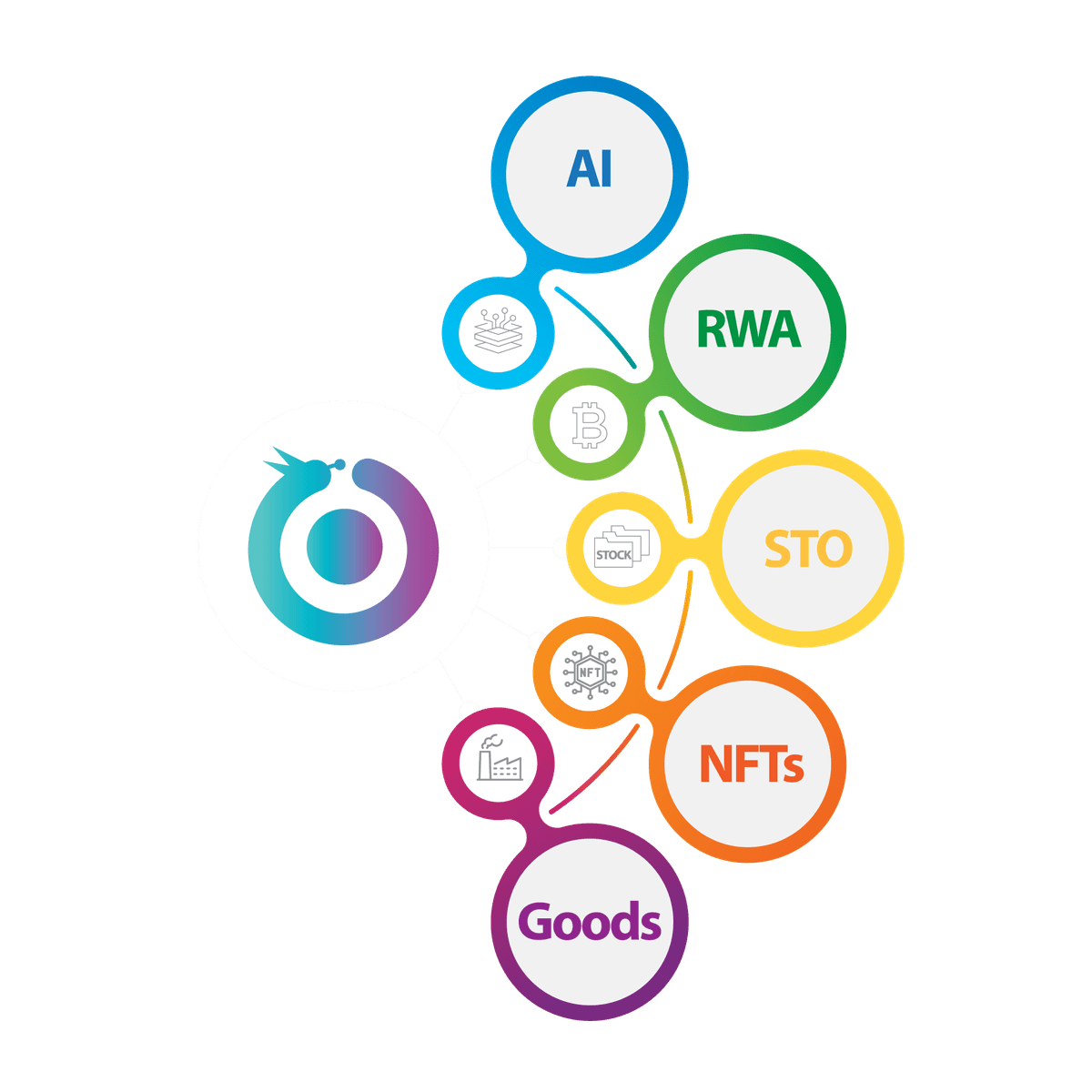

AI(Artificial Intelligence)
CoReset is a rights and settlement infrastructure for the AI era.
AI companies can lawfully utilize data, while rights holders can protect their rights and receive fair royalty settlements for the use of their data and content.
Through this framework, CoReset supports a sustainable ecosystem where AI innovation and creator protection can grow together.

RWA(Real World Assets)
Digital financial institutions and asset managers require rights verification and settlement infrastructure to digitize real-world assets such as real estate, artworks, and commodities.
CoReset provides technologies for third-party enforceability, rights verification, permission management, and settlement recordkeeping, enabling RWA businesses to build more trusted and reliable services.

STO(Security Token Offering)
Provides innovative companies and financial institutions seeking to convert traditional financial assets into blockchain-based securities with compliant yet flexible asset management.
A royalty-based distribution system ensures transparent profit allocation for investors.

NFTs(Non-Fungible Tokens)
Issues ownership and copyrights of creative works—such as digital art, music, and videos—as NFTs.
With CoReset’s technology resolving third-party copyright issues, works with multiple copyright holders can be safely tokenized and traded as NFTs.

Goods
Supports B2B, B2C, G2G, and G2B entities by developing forward trading systems for physical goods and services.
By utilizing a competitive forward trading database, future value of goods is tokenized and direct supplier–consumer transactions are mediated via blockchain.

Integrated Ecosystem
Companies operating across AI, RWA, STO, NFTs, and Goods are connected around the CoReset Token to form a unified digital economic ecosystem. Synergies across sectors enable new business models and value creation.
Contact Us
Join the Revolution
For government-enterprise cooperation (G2B), business collaboration (B2B),
or partnerships, please feel free to contact us at any time.
Join CoReset to build the future of data sovereignty.
25, Digital-ro 32-ga-gil,
Guro-gu, Seoul
25, Digital-ro 32-ga-gil,
Guro-gu, Seoul